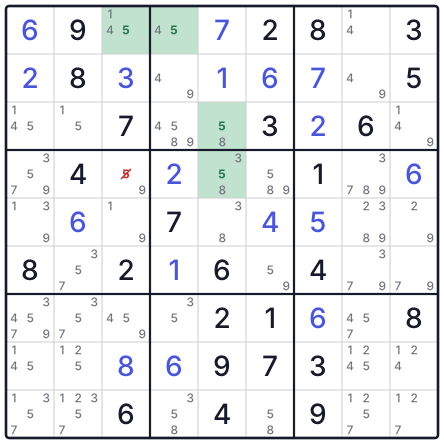
- Look at the highlighted cells.
- Look at their notes: whichever way they are filled, the same notes are ruled out.
- So 5 can be removed from the crossed-out cells.
A 2-String Kite is about one number in one row and one column. In the row the number can go in only two cells, and the same holds in the column. One cell of the row and one cell of the column lie in the same box. The other two cells are the far ends of the two strings, and any cell that sees both of them loses the number.
Or scan with your phone
Pick a number and find a row and a column where it is noted in exactly two cells each. Check whether one end of each lies in a common box, without being the same cell. The cell to clean up is where the row of one far end crosses the column of the other.
The box can hold the number only once, so at most one of the two cells in it has it. The line whose cell in the box is empty must have the number at its far end. So at least one far end holds the number, and a cell that sees both cannot.
This is 2-String Kite on its practice puzzle, at the first step that needs it. The game's hint explains the step like this:
This Extreme puzzle calls for 2-String Kite. Fill in the singles first. When no number is obvious any more, look for the pattern, or ask for the hint: each game has one.